
Some projects announce themselves from the street. The Rollingwood Residence doesn't. From the road, it reads as a compact, carefully composed modern home on a wooded lot — restrained, even modest by the standards of the Austin luxury market. Walk through it, and the restraint reveals itself as precision. The house cascades down a steep hillside through a series of stepped levels, each one reaching further into the tree canopy, until the screened porch at the lower end feels genuinely suspended in the oaks. The project has been published in Dwell and featured on the AIA Austin Homes Tour, and it deserves both.
Lake|Flato associate Brian Comeaux led the design. The firm has been practicing out of San Antonio and Austin since 1984, and their work has a consistent quality of regional attentiveness — buildings that read the climate, the topography, and the existing landscape before they commit to a form. The Rollingwood Residence is that sensibility applied to a double-wide lot on a horseshoe-shaped street in one of Austin's quieter enclaves, ten minutes from downtown but dense with old oaks and backed by a creek. The brief from the owners was direct: small but highly designed. Not a McMansion. A house scaled to how two people actually live.
That brief produced a 2,400-square-foot home that accomplishes more per square foot than almost anything I've photographed at twice the size.
A House That Follows the Hill
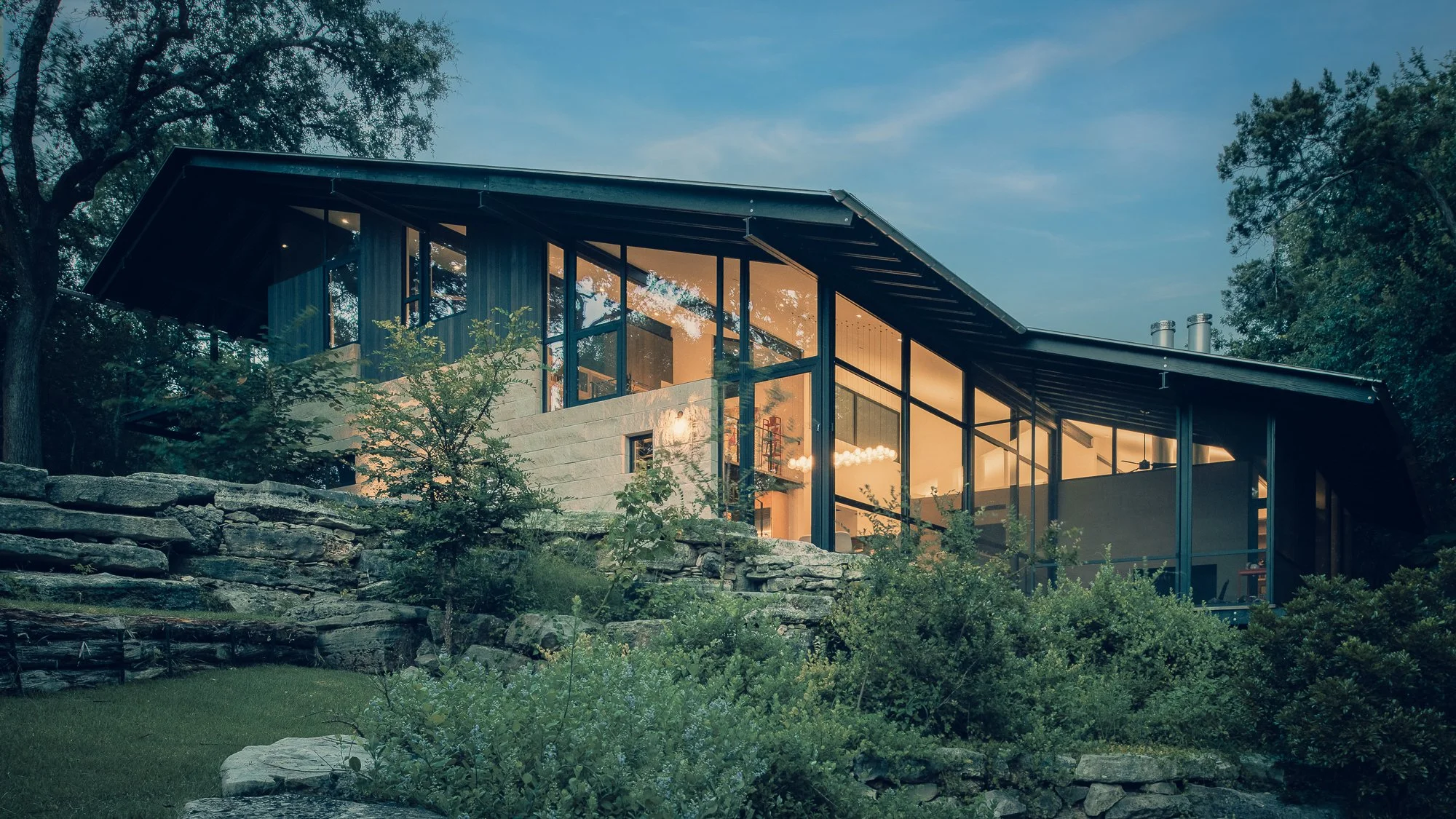
The site drops steeply from the street toward the creek below, and the architecture doesn't fight it. The program is stacked in terraced levels that step down the slope, with the main living volume at the top and the primary bedroom and screened porch cantilevered at the lower end above the tree canopy. An offset gable roof follows the grade of the land, its floating geometry guiding the eye downhill toward a path of restored rock ledges — hand-laid by the owners themselves — that leads to a dry creek, a small amphitheater, and a private gathering space carved from the existing rock outcroppings.
This is the move that makes the Rollingwood Residence worth studying: the house and the landscape are designed together, each one making the other more legible. The architecture gives you elevated vantage points into the oaks. The landscape gives the architecture something worth looking at from every window. Comeaux describes Rollingwood as a hidden gem, and this lot — dense with mature trees, backed by a creek, close enough to downtown to be convenient but quiet enough to feel removed — earns that description. The compact driveway and building footprint were pushed to the west edge of the property specifically to leave the natural green space to the east undisturbed.
The siting decision isn't incidental. It's the first architectural move, made before a wall goes up. Photographing a house like this means understanding that the relationship between building and land is the subject — not just the building.
The Materials Argument
The exterior is Western red cedar and Lueders limestone. Both are materials with a history in Texas architecture, chosen here for the same reason they've always worked in this climate: they're honest, they age well, and they read as belonging to the landscape rather than imposed on it. The cedar will silver over time. The limestone, quarried from the same general geology as the creek rock below the house, ties the building to its site in a way that's almost geological.
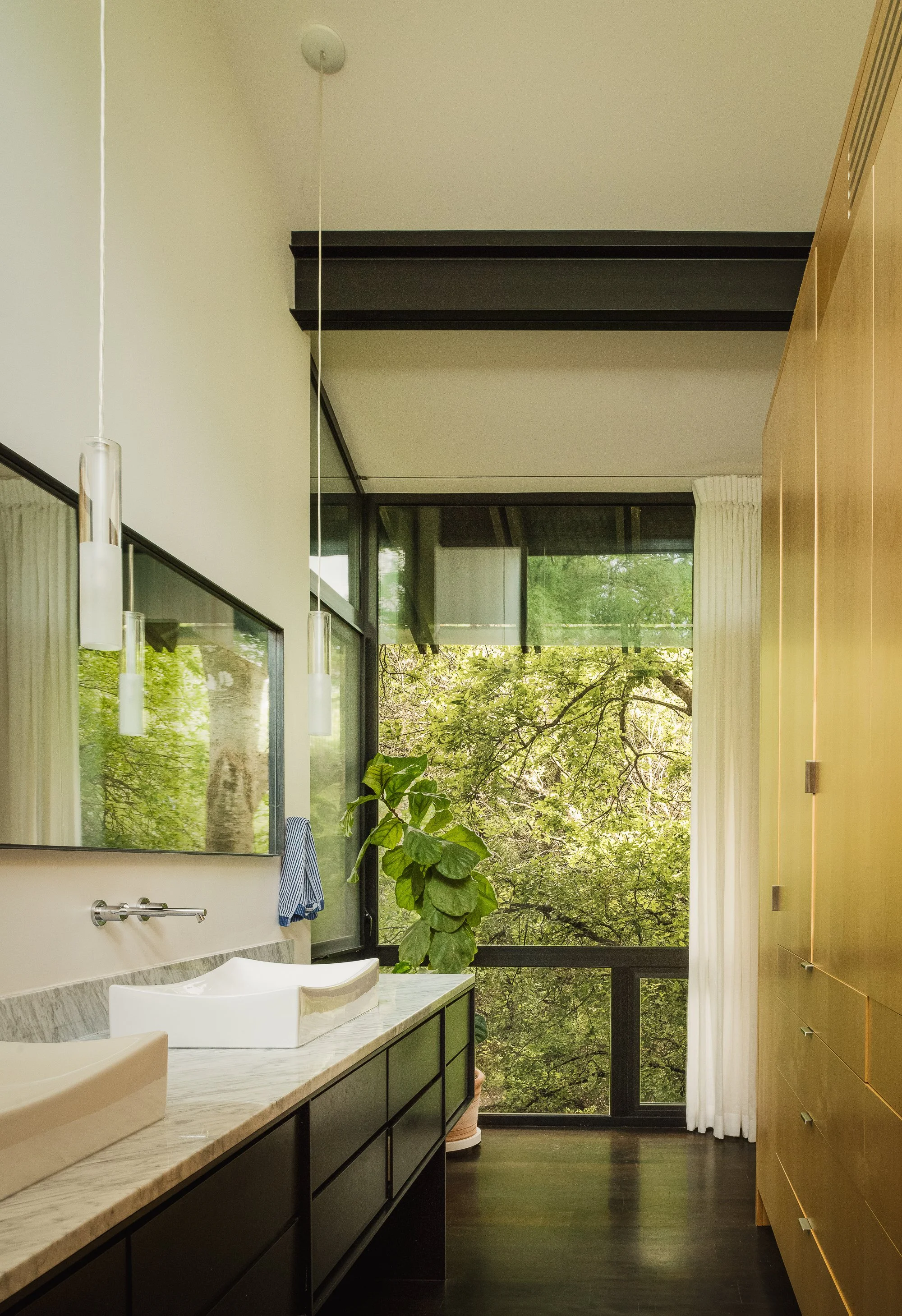
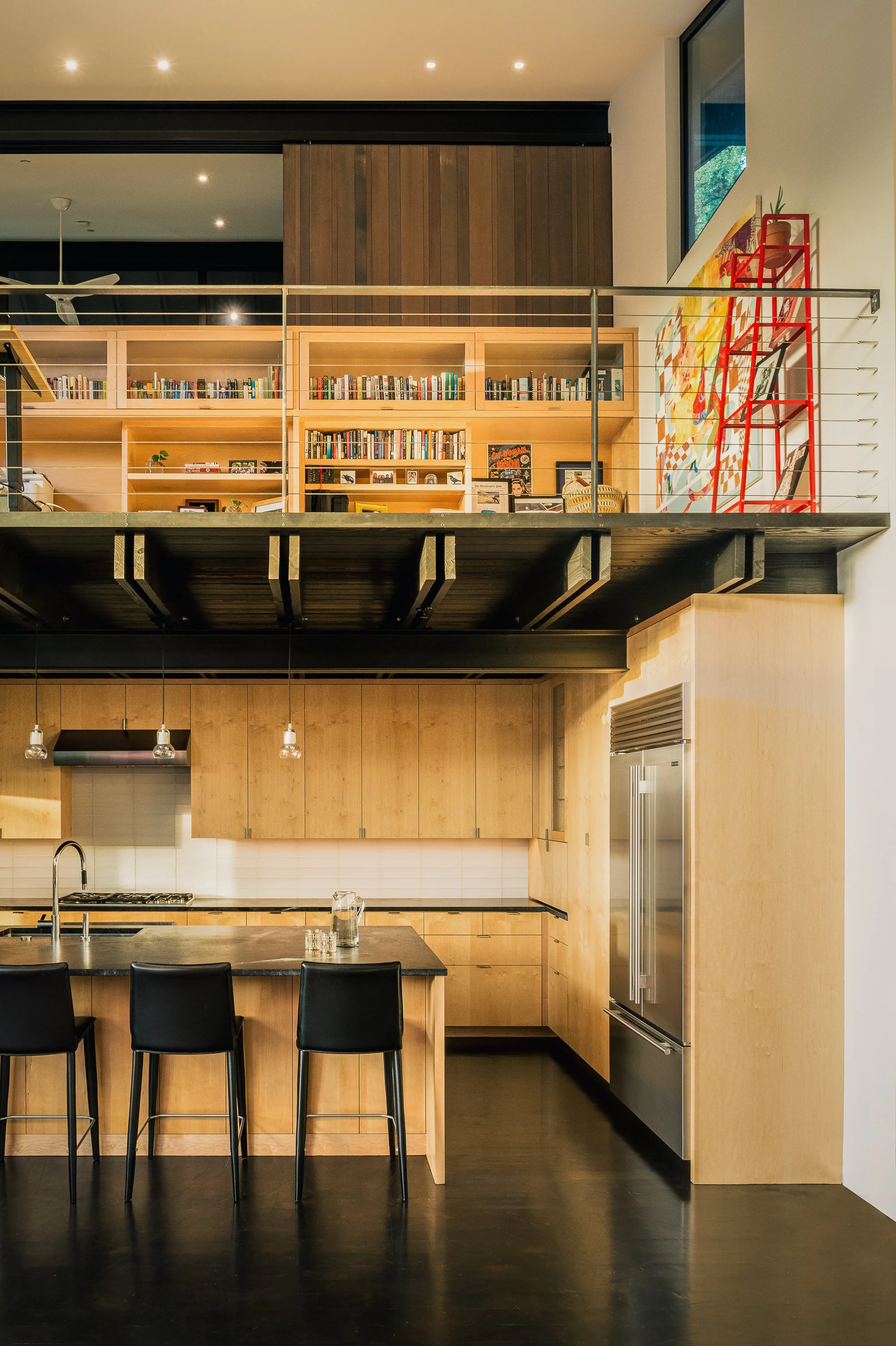
Inside, the palette shifts but maintains the same logic. Blackened mesquite floors anchor the main living level — a material that's distinctly Texan, dark and rich against the lighter tones of the clear sealed maple millwork. Soapstone countertops in the kitchen. Honed limestone underfoot in other areas. Douglas fir joinery, left exposed in the ceiling plane, brings warmth to the upper reaches of the 18-foot living room. Every material selection was made, Comeaux explains, by thinking about the house as a whole collection — nothing chosen in isolation, everything evaluated against what it sits next to.
This approach to material restraint is something I encounter in the best architectural work and rarely in lesser projects. When a design team has exercised this kind of discipline, the photographer's job is clarified: show the materials clearly. Don't dramatize. Let the palette do the work. A room with blackened mesquite, maple millwork, and soapstone doesn't need to be lit dramatically. It needs to be shown honestly, with light that reveals texture and relationship rather than manufacturing atmosphere.
The Living Room and the Glazed North Facade
The main living volume is where the spatial ambition of the project is most concentrated. An open plan combines kitchen, dining, and living under 18-foot ceilings, with a glazed northern facade that runs floor-to-ceiling across the primary view. The orientation is deliberate — north light is consistent, diffuse, and doesn't create the harsh contrast shadows that direct southern exposure would in a Texas summer. The view through those windows is into the oaks, and at certain times of morning, the light filtering through the canopy into the living room has a quality that's almost aquatic — green-tinged, moving, alive.
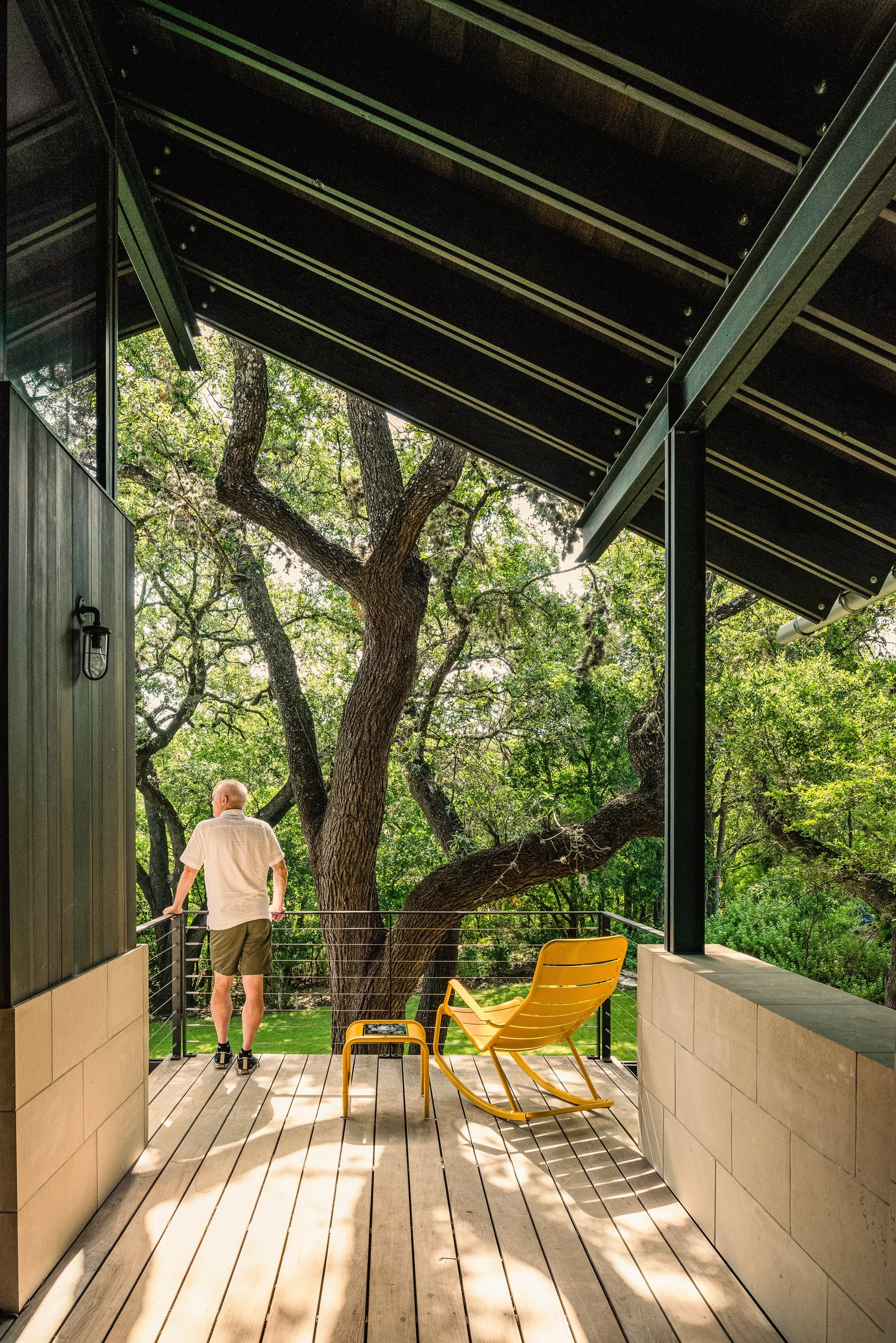
The fireplace anchors one end of the main level. A few steps down, through a spatial compression that works the way good section design always does — making the release feel earned — the screened porch opens off the primary bedroom. Cantilevered over the surrounding canopy, with an imposing stone fireplace of its own and screens that frame the oaks rather than blocking them, this porch is where the treehouse analogy stops being a metaphor. You're genuinely in the trees. The floor is hovering over sloped ground. The branches are at eye level. The owners chose this house because they wanted to feel close to the landscape, and this is the room where the design delivers that most completely.
Photographing the screened porch required the same patience as the Camp Frio porches — managing the light differential so the screen reads as transparent rather than as a visual barrier, finding the moment when interior and exterior are in close enough balance that the camera can see through rather than stopping at the mesh. Late afternoon worked best, with warm interior light beginning to assert itself against a softening exterior.
Two Masters, One House
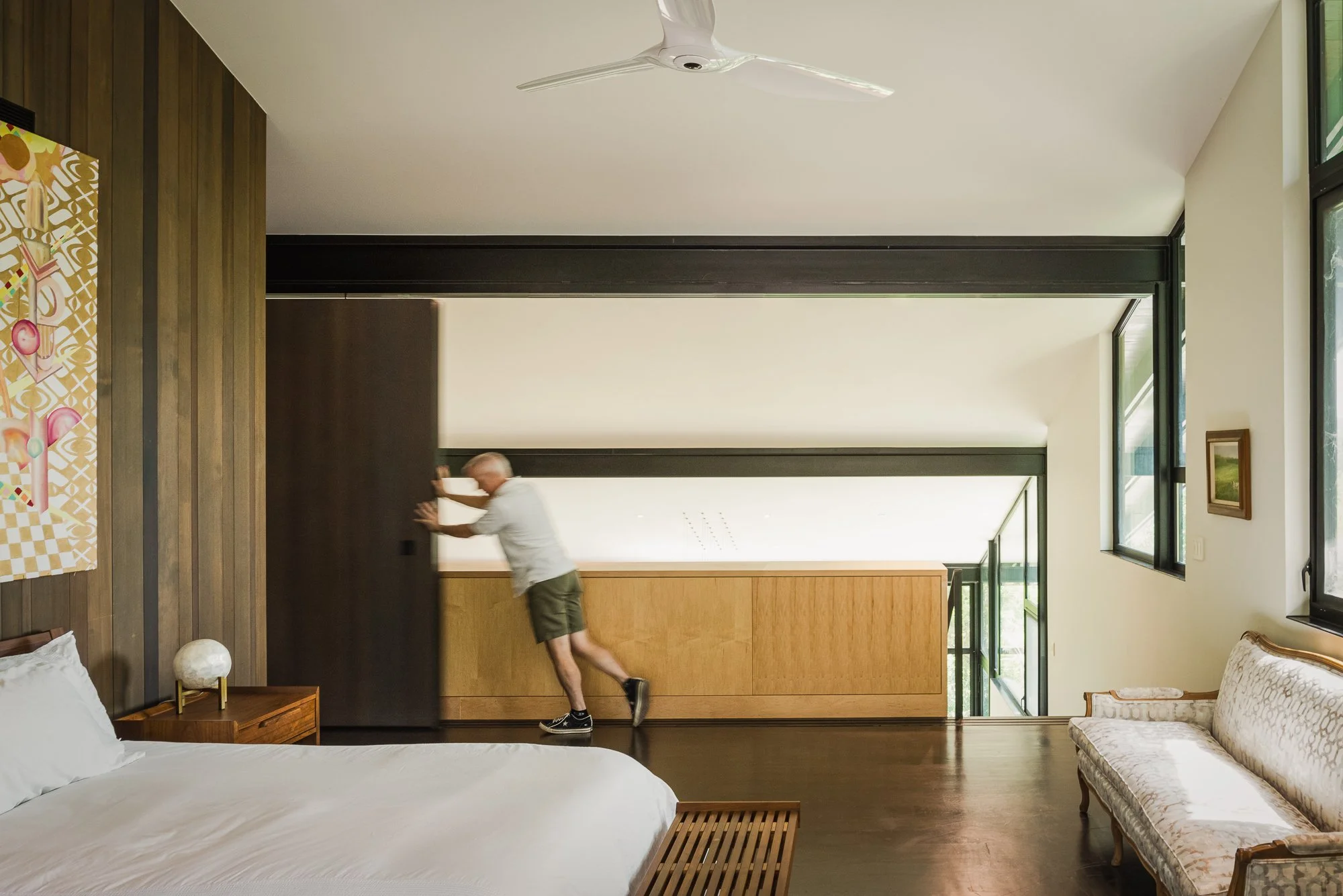
The spatial organization of the bedrooms is one of the more unusual features of this project, and worth understanding. Both bedrooms are designed as primary suites — the downstairs suite positioned for hot Texas summers, the upstairs one for cooler months, with a second-floor porch shaded by a large oak and dark slate tiling in the bath. The millwork in the downstairs suite stops short of the ceiling, allowing light to spill from the main space into the master bath — a detail that's invisible in a floor plan and immediately legible in person.
This seasonal flexibility in how the house is occupied is a genuinely thoughtful response to Austin's climate. It also reflects the owners' approach to the project overall: a house designed around how two people actually live, rather than how a house is supposed to be presented. No rooms they wouldn't use. No space for its own sake. The Dwell article quotes them directly: "A bigger house isn't always a better house."
That's the kind of conviction that produces architecture worth photographing.
Why This Project Holds Up
The Rollingwood Residence was completed and published in Dwell in early 2020. It appeared on the AIA Austin Homes Tour. It continues to appear in Lake|Flato's portfolio and in Shoberg Homes' project list as one of the cleaner examples of what a high-craft, site-responsive Austin residence can be.
What strikes me about projects like this — compact, precise, deeply considered — is how well they photograph over time. The restraint that might seem understated in person reads as confidence in an image. There's nothing to remove, nothing that was included for effect. Every material, every spatial relationship, every view through a window was considered as part of a whole. The camera finds that coherence and holds onto it.
This is what I try to bring to every project I photograph: the same attention the architects brought to the design. Not to illustrate a building, but to reveal it. The Rollingwood Residence rewards that approach.
Project Details Architecture: Lake|Flato Architects — Brian Comeaux Builder: Shoberg Homes Lighting Design: David Nelson & Associates Cabinetry: HEWN Structural Engineer: Structural Design Consulting Location: Rollingwood, Austin, Texas Size: 2,400 square feet Published: Dwell Recognition: AIA Austin Homes Tour Photography: Tobin Davies
Tobin Davies is a luxury architectural and interior photographer based in Austin, Texas. He works with architects, interior designers, builders, and developers on residential and commercial projects throughout Texas and nationally. For shoot inquiries, visit tobindavies.com/contact.