
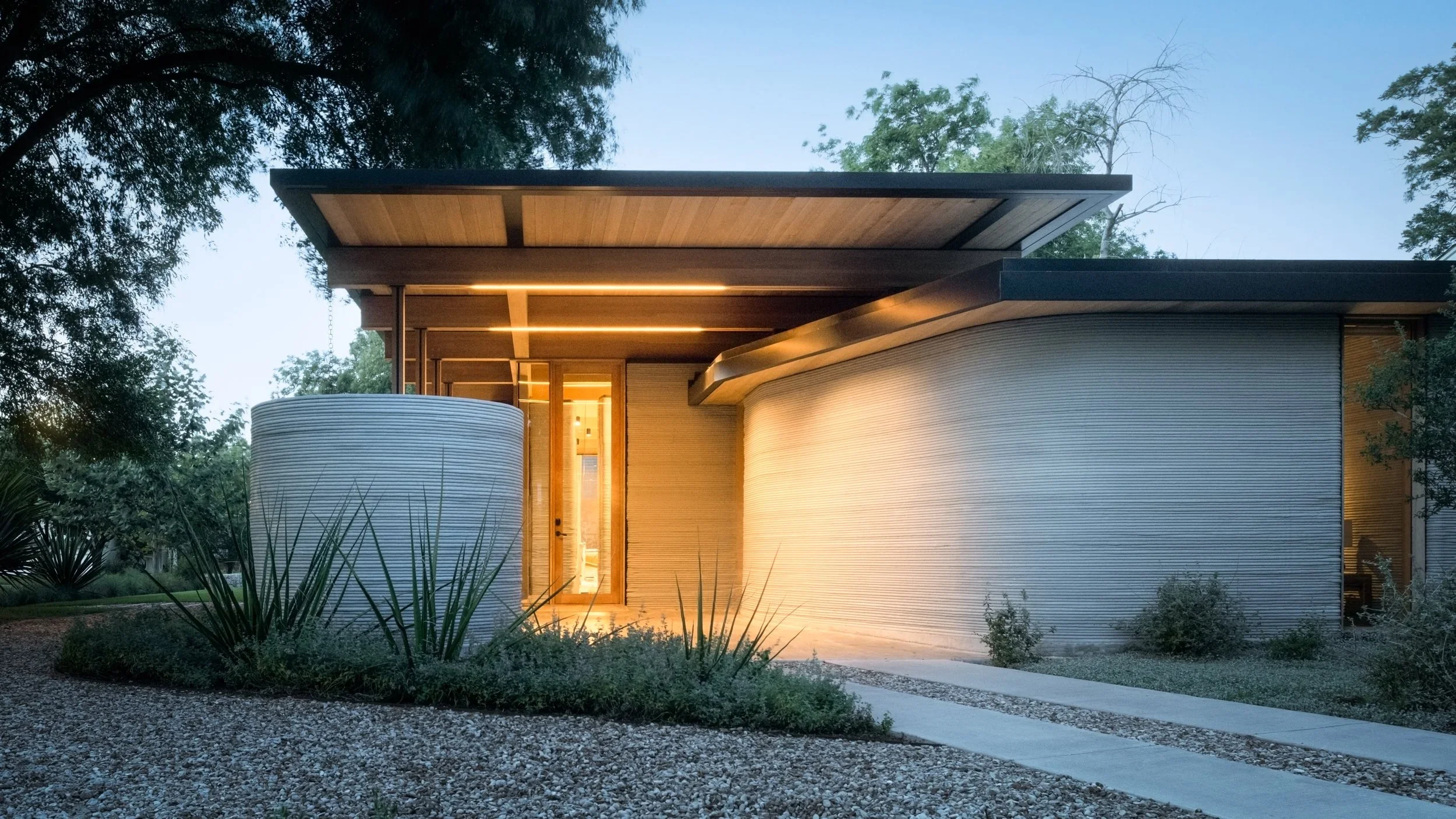
Some buildings ask to be photographed differently. House Zero is one of them.
When ICON and Lake|Flato Architects completed their collaboration in East Austin in the spring of 2022 — timed deliberately to coincide with SXSW — the architectural world took notice immediately. A 2,000-square-foot, three-bedroom home with walls made of Lavacrete, a proprietary cementitious material extruded by a 9,500-pound robotic printer over the course of ten days. Curved surfaces, no hard corners, clerestory windows angled to capture the soft eastern light of an Austin morning. By the end of that year, TIME magazine had named it one of the 200 Best Inventions of 2022. Fast Company followed with an Innovation by Design award. The Texas Society of Architects added a TxA Design Award. Two Architizer A+ Awards after that.

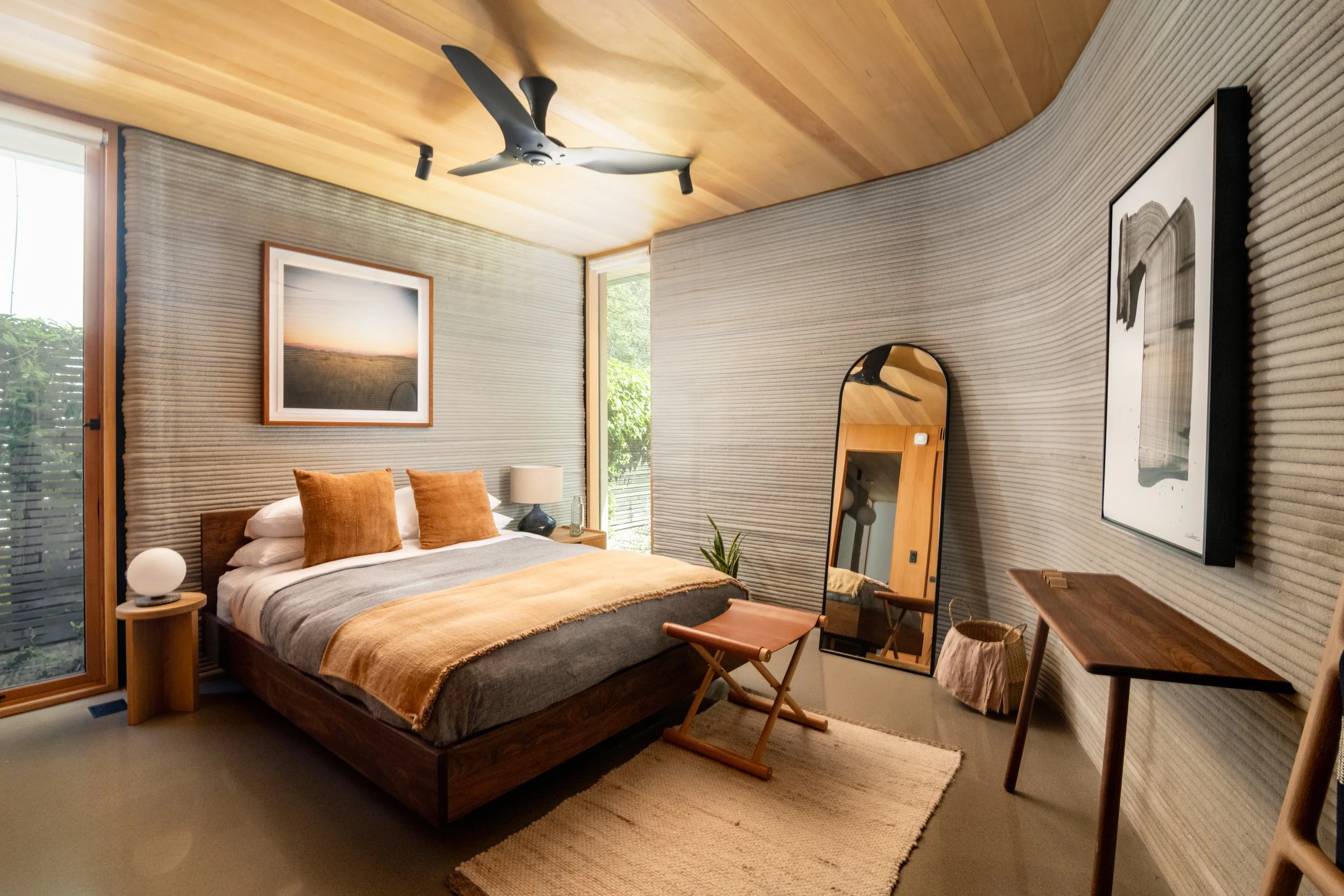
What makes a project like this challenging to photograph isn't its novelty — it's that novelty can overwhelm. The temptation is to lead with the technology. The ribbed texture of the Lavacrete walls. The way the printing layers stack visibly, like geological strata. Those details are real and worth showing. But the architecture that Lake|Flato designed here isn't a technology demonstration. It's a home — mid-century modern in spirit, biophilic in intention, rooted in the kind of regional sensibility that Lake|Flato has practiced since 1984.

The framing I kept returning to during this project: what a really good mid-century ranch house wants to be, freed by new technology from the constraints that conventional construction imposes. That became the photographic mandate. Shoot House Zero the way you'd shoot any exceptional piece of architecture — as a place where light, material, and proportion have been considered with care — and let the construction story surface through the images rather than dominate them.
The eastern-facing clerestory windows were the first thing I studied on site. Lake|Flato placed them to minimize the need for electric light during daylight hours, and the quality of what they admit into the living room at certain times of morning is extraordinary — diffuse, directional, warm against the cool Lavacrete. The flat roof with its cantilevered awnings creates a geometry that rewards a long lens from the street. And the rounded corners that ICON's Vulcan printing system makes possible — corners that conventional framing and drywall simply cannot achieve — create soft transitions between interior spaces that read on camera as something genuinely new. Not futuristic. Just quietly different from every other house you've ever photographed.
The site itself shaped the approach. House Zero sits at 1700 Riverview Street in East Austin's East Cesar Chavez neighborhood, where ICON used it for several years as a living showcase before bringing it to market. The surrounding context is modest — a working-class neighborhood mid-gentrification, a mix of original bungalows and new infill. That contrast is part of the story. The house doesn't try to disappear into its surroundings. It doesn't try to dominate them either. It occupies its lot with a confidence that comes from knowing exactly what it is.
Lake|Flato, the San Antonio and Austin-based firm that designed it, received the AIA's Firm of the Year Award and has been recognized by ARCHITECT Magazine as the top-ranked firm in the United States. Their practice is built on a deep reading of climate, site, and regional material culture — and House Zero, despite its technological novelty, is a Lake|Flato building through and through. The curved walls track the sun. The overhangs are sized for the Texas latitude. The palette is restrained and rooted in the landscape. Photographing their work is a responsibility I take seriously, because their buildings reward the kind of attention that most photography rushes past.
House Zero is the kind of project that reorients your sense of what's possible — not just in construction, but in what architectural photography needs to do to keep up. The buildings are getting more interesting. The documentation has to match.
Photography by Tobin Davies. Architecture by Lake|Flato Architects. Construction technology by ICON.
Tobin Davies is an architectural photographer based in Austin, Texas, working with architects, interior designers, and developers across Texas and nationally. Available for new projects.