
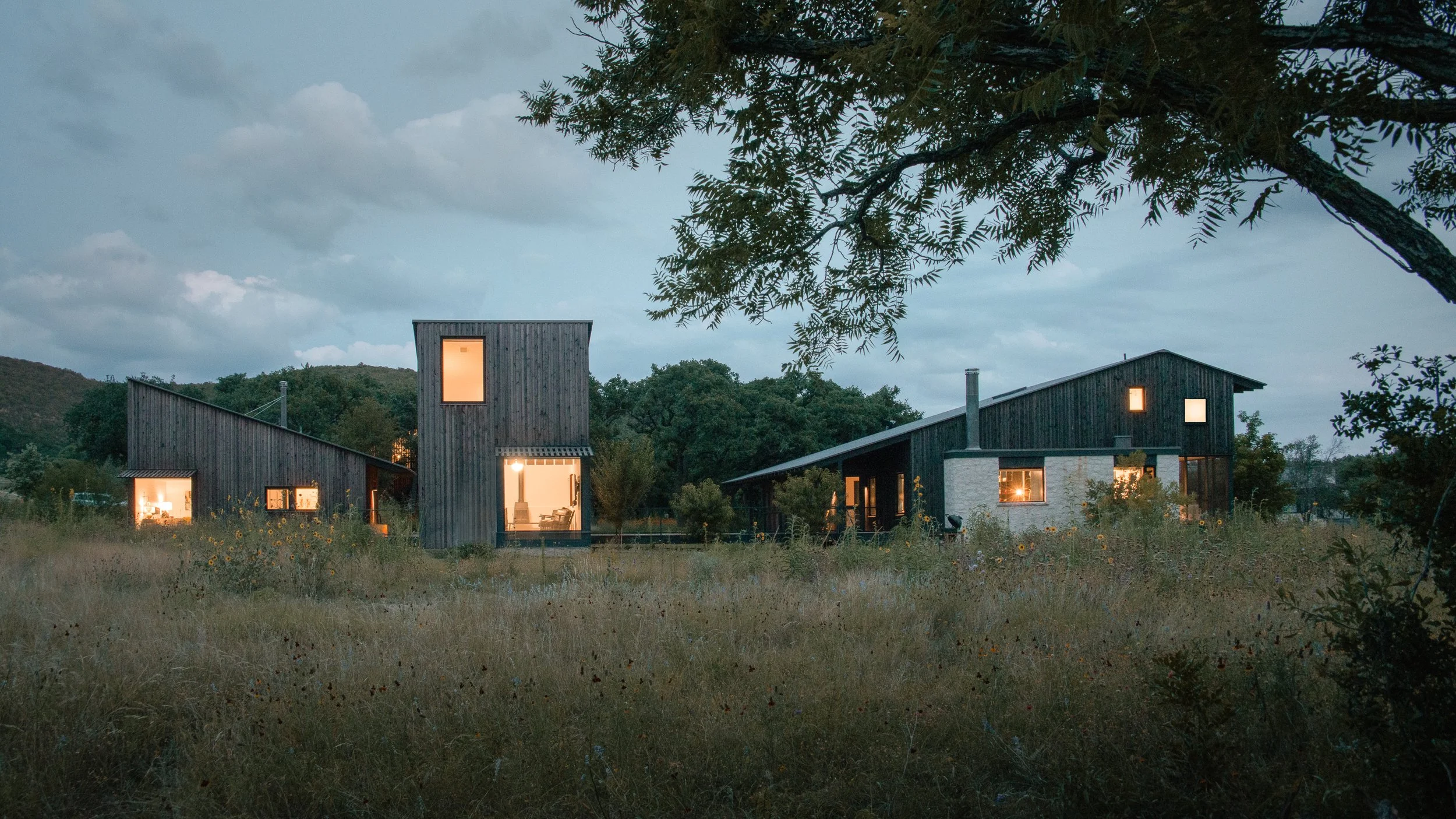
A short drive southwest of Austin, the Hill Country opens up into something older and quieter. The roads narrow. The cedar thickens. The Frio River — spring-fed, cold, running clear over limestone — cuts through valleys that feel unchanged in any meaningful way. This is where Camp Frio sits: a multi-structure family compound designed by Tim Cuppett and David Kilpatrick of Cuppett Kilpatrick Architects, built by Dalgleish Construction on a 2.8-acre riverfront parcel in the small town of Leakey, Texas.
I photograph a lot of luxury residential work in and around Austin. Modern homes with clean lines, sophisticated material palettes, Hill Country views. Camp Frio is something different. It's not trying to impress you with scale or finish. It's trying to get you outside. That distinction changes how the architecture works — and how you photograph it.
Architecture That Wants You to Leave
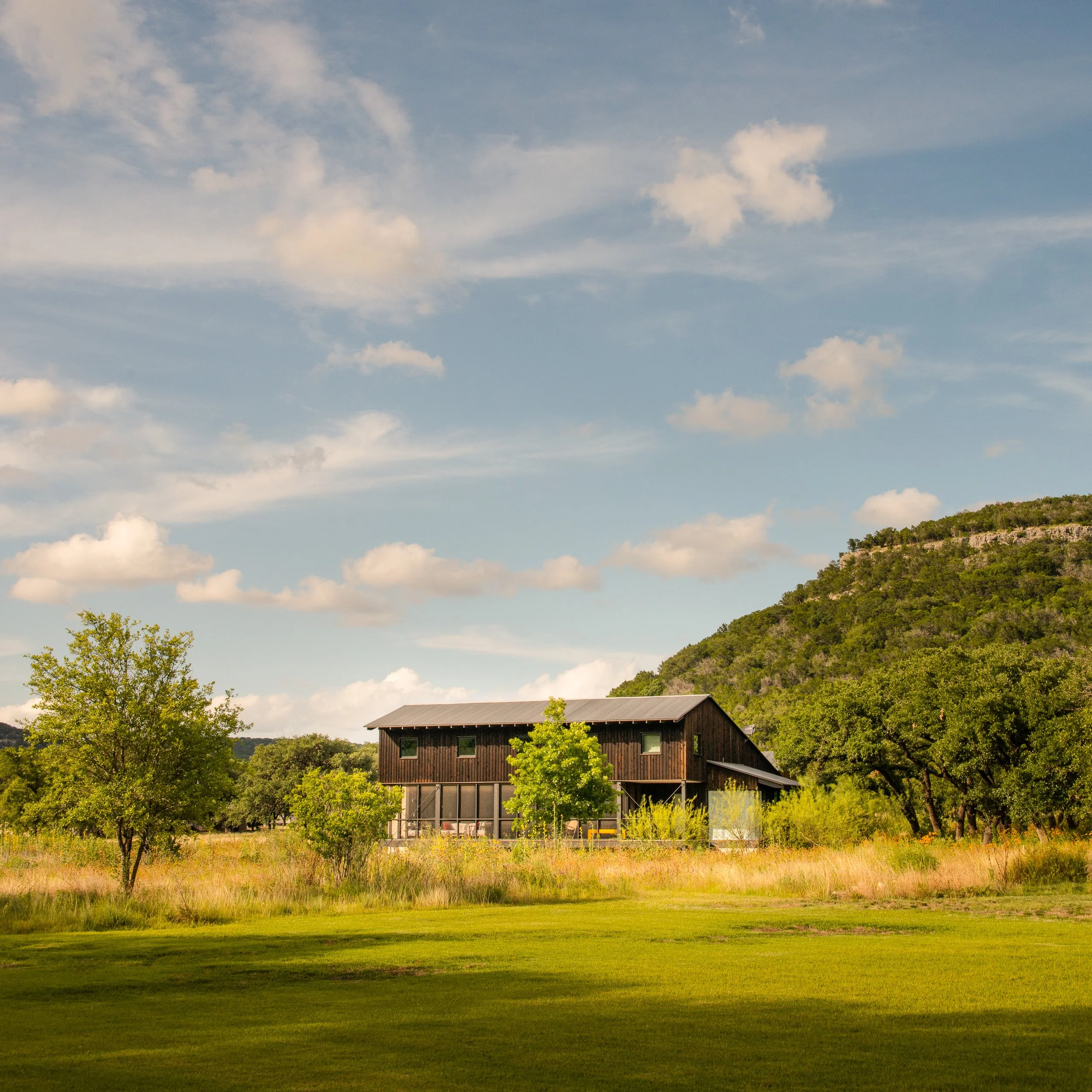
Tim Cuppett has talked about this openly: the design intent for Camp Frio was to make the indoors secondary to the outdoors. To build spaces that are comfortable enough to sleep in and cook in, but that constantly pull you toward the river, the grass, the sky. Most second-home architecture does the opposite — it imports the expectations of a primary residence into a vacation setting, resulting in houses that are oversized, over-finished, and disconnected from the land they sit on.
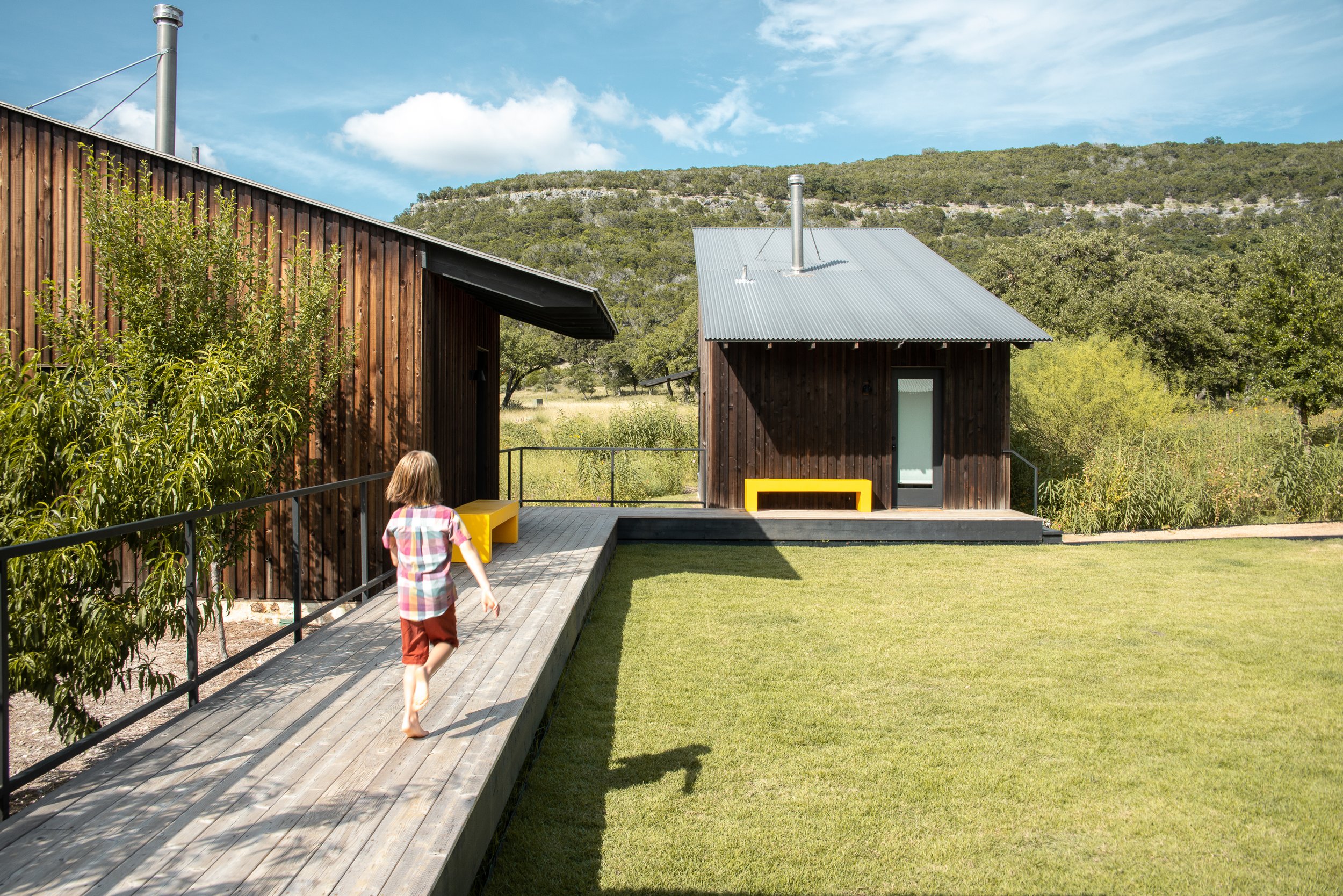
Cuppett and Kilpatrick took a different approach. They broke the program into four separate structures: a main house with a partial second-level bunkroom, two guest cottages with sleeping lofts, and a garage building with an art studio on the ground floor and a meditation room above. The structures are connected by a slightly elevated walkway that lets kids run barefoot between buildings without worrying about what's in the tall grass below. The compound reads less like a single house and more like a small settlement — a cluster of shelters scaled to the valley they occupy.
For photography, this distributed layout is both a challenge and an opportunity. You can't capture Camp Frio in a single hero shot the way you might a monolithic residence. You have to move through it. The story is in the relationships between buildings — how they frame views of each other, how they create outdoor rooms in the spaces between them, how the compound as a whole relates to the river and the meadow. I spent as much time photographing the negative space between structures as I did the interiors.
The Modern Dogtrot
The main house is organized around a central breezeway — a contemporary interpretation of the dogtrot, the open-passage house form that defined rural Southern architecture for generations. Concealed multi-slide doors on both ends of the breezeway allow it to function as an open-air dining room for most of the year. Close the doors in winter and it becomes an enclosed space with heating. A skylight above brings natural light into the center of the plan regardless of the season.
This is the architectural move that defines the project. The breezeway is the social heart of Camp Frio — the place where meals happen, where families gather, where the boundary between inside and outside dissolves completely on a warm evening. Photographing it required patience. The space reads differently depending on whether the doors are open or closed, whether the light is entering from the skylight above or from the landscape at either end. The best frame I found was from within the breezeway looking outward, with the Hill Country visible through the open doors — a shot that captures the dogtrot idea perfectly. You're sheltered but not enclosed. Protected but not separated.
The living room adjacent to the breezeway is its deliberate opposite: intimate, dark, moody. The owners described the duality as wanting spaces that are simultaneously cozy and spacious, dark and bright. Cuppett achieved this by keeping the living room compact with lower ceilings and wrapping it in rich, saturated color — guided by the homeowner, who has a background in art. The contrast between the bright, breezy dining breezeway and the cool, enclosed living room is one of the most interesting spatial sequences I've photographed. It's the architectural equivalent of stepping from a sun-drenched porch into a shaded interior on a hot day. Your eyes adjust. Your body relaxes. The architecture is doing exactly what the Hill Country climate asks it to do.
Materials That Belong
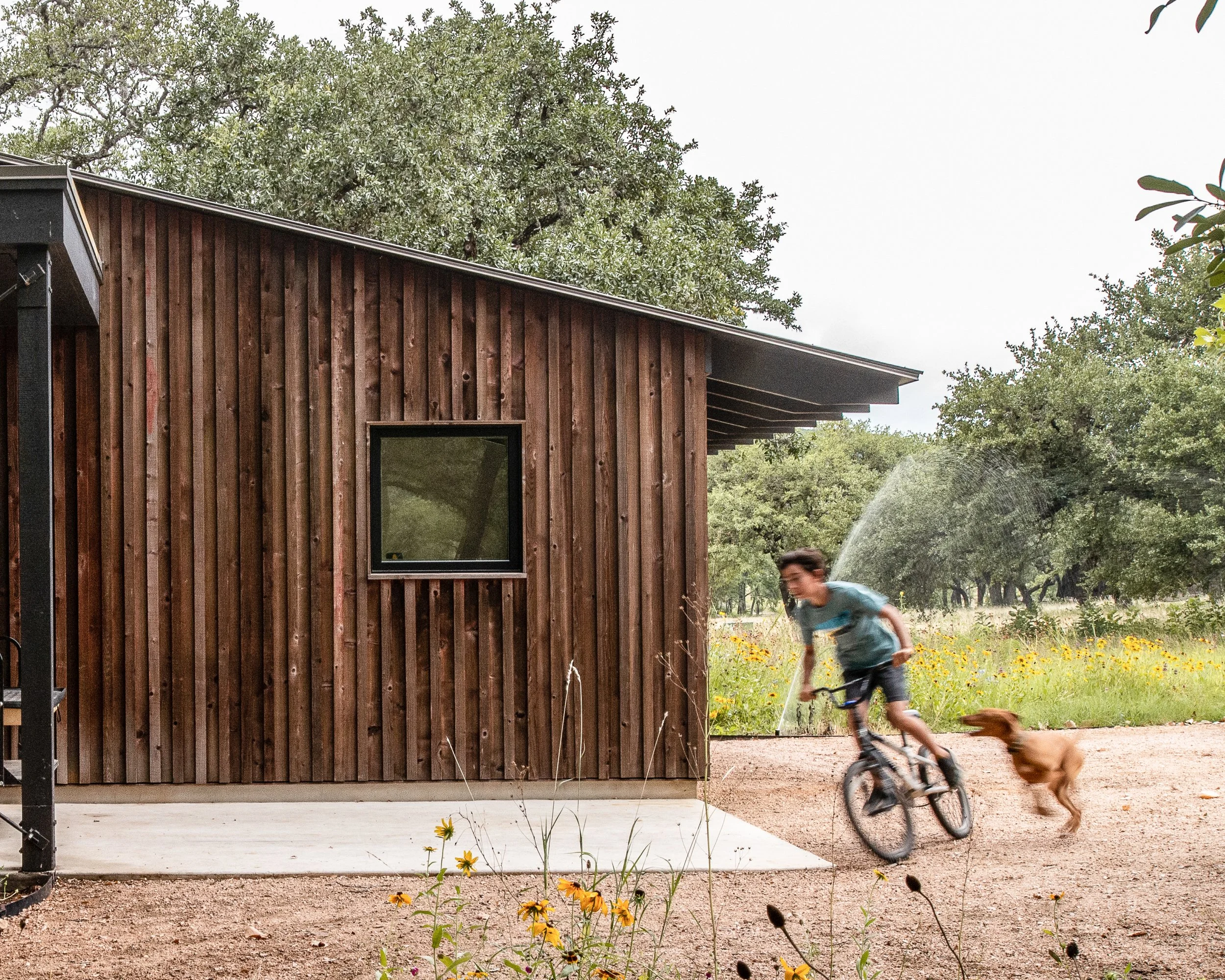
Camp Frio is built with materials sourced to match its context: rough-sawn cedar siding, Galvalume metal roofing, foundations clad in local limestone, and wire-brushed Douglas fir floors throughout. The palette reads as contemporary but rooted — modern in its composition and detailing, vernacular in its texture and tone. From a distance, the dark cedar structures could have been standing in this valley for decades. Up close, the precision of the joinery and the quality of the hardware tell a different story.
This is something Cuppett Kilpatrick does exceptionally well. Their design philosophy, which they describe as governed by the idea of editing, produces buildings that feel reduced to essentials without feeling austere. Every material earns its place. The cedar will weather and silver over time, drawing the buildings closer to the colors of the surrounding landscape. The metal roofs shed Hill Country rain efficiently and catch light in a way that reads beautifully at dusk, when the sky goes violet and the structures take on a warm glow from interior lighting.
Photographing these materials in the Frio River valley is different from photographing them in Austin. The light out here is harder, more direct, with fewer ambient surfaces to bounce fill into shadow areas. The landscape is bigger and less manicured. The sky takes up more of the frame. All of this pushes you toward a documentary approach — showing the buildings as objects in a landscape rather than as isolated compositions. The best images from this shoot feel like they could belong in a regional architecture monograph: the buildings small against the land, the materials honest, the relationship between structure and site legible at a glance.
Screened Porches and Sleeping Lofts
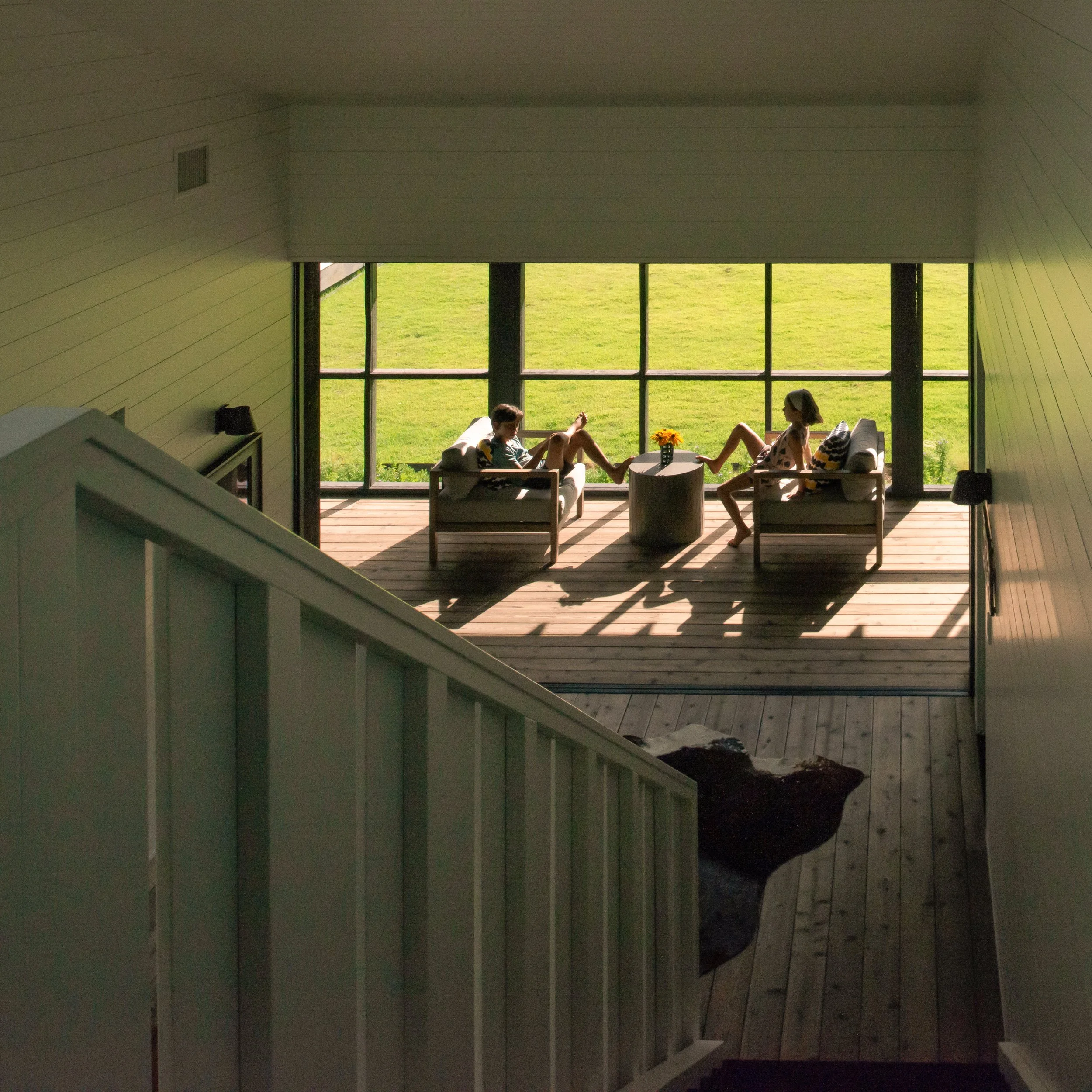
The screened porches at Camp Frio are not afterthoughts. They're primary living spaces — cozy rooms wrapped in screen that function as an intermediate zone between the sealed interior and the open landscape. On warm evenings, these porches become the most desirable rooms in the compound. They catch the breeze off the river. They keep the insects out. They let you hear the sounds of the valley — wind through the cypress trees, water moving over rock, the particular quiet that settles over the Hill Country after dark.
The guest cottages each contain a sleeping loft above the main level, accessed by a ladder. These lofts are sized for kids or for adults who don't mind climbing, and they reinforce the camp aesthetic that gives the project its name. There's nothing precious about these spaces. They're functional, well-built, and designed to encourage the kind of informal, multi-generational gathering that the owners envisioned. Families and friends spread across the compound, each group with its own cottage, connected by the walkway and drawn together at the breezeway for meals.
Photographing the screened porches presented an interesting technical challenge. Screen mesh can read as a visual barrier in photographs if the light isn't managed carefully — the camera sees the screen more aggressively than the eye does. The key is shooting when the light differential between inside and outside is minimal, so the screen becomes transparent rather than opaque. Late afternoon and twilight were the windows where these spaces photographed most honestly — the interior warm and inviting, the landscape beyond visible and in conversation with the room.
Frio Cañon and the Legacy Community
Camp Frio sits within Frio Cañon, a larger development conceived by builder David Dalgleish as a legacy community — a place designed for multi-generational family use, with a hundred acres of wildlife preserve, hiking trails, and community gathering spaces. Dalgleish, who built Camp Frio through his firm Dalgleish Construction, has maintained strict design guidelines for the community, working only with a curated list of architects to ensure that new construction respects the character of the land.
That context matters. Camp Frio isn't an isolated vanity project dropped onto a rural lot. It's part of a broader vision for how people can build in the Hill Country without consuming it. The architecture is sized to the site. The materials are sourced for longevity and regional appropriateness. The structures sit lightly on the land. These are values that show up in the photographs — not as talking points, but as visual qualities. When the architecture is right for its place, the camera recognizes it.
Why This Project Matters
Camp Frio has earned a 2019 Texas Society of Architects Design Award, a 2021 AIA Austin Design Award of Merit, a 2021 Architizer A+ Awards finalist designation, and features in ArchDaily, Dwell, Residential Design Magazine, and numerous architecture publications worldwide. That's a remarkable run for a 3,600-square-foot family retreat in a town of fewer than 500 people. The recognition reflects something important: this project has resonated with architects and design audiences far beyond Texas because it speaks to a set of ideas — about simplicity, about site, about what a second home should actually be — that are universally compelling.
For Cuppett Kilpatrick, Camp Frio represents the firm's design philosophy at its most distilled. Their practice is governed by Alexander Pope's directive to consult the genius of the place, and this project does exactly that. The genius of this place is the river, the valley, the quality of Hill Country light, and the particular feeling of being far enough from the city that the noise falls away. The architecture amplifies all of it.
This is the kind of project that expands a photography portfolio in valuable ways. My work is anchored in Austin — modern residential, urban and suburban contexts, clean-lined homes on manicured lots. Camp Frio shows something different: that the same photographic discipline applies in a rural, vernacular context. That the principles of reading light, understanding material, and revealing design intent don't change when the setting does. The audience that discovers these images on my site often arrives looking for Texas modernism and stays because the range of work tells a more complete story about what architectural photography can do.
Project Details Architecture: Cuppett Kilpatrick Architects — Tim Cuppett, David Kilpatrick Builder: Dalgleish Construction — David Dalgleish Interior Design: Homeowner with Adriana Chetty, Cuppett Kilpatrick Architects Landscape: Lionheart Places — Rebecca Leonard Engineering: Arch Consulting Engineers Location: Leakey, Texas (Frio Cañon) Size: 3,600 square feet (conditioned space), 2.8-acre site Completed: 2018 Awards: 2019 TxA Design Award, 2021 AIA Austin Design Award of Merit, 2021 Architizer A+ Awards Finalist Photography: Tobin Davies